
With the Highlands-Cashiers Land Trust
Words by Emily Davis
 photography by Andrew Renfro, courtesy of the Highlands-Cashiers Land Trust
In the present day, the Highlands-Cashiers Plateau serves as a vacation destination for those seeking cool mountain air, prestigious golf courses, fine dining, and charming shops. While perhaps not the busiest or most bustling spot in the Southeast, the area enjoys enthusiastic popularity among those who know and love it. In recent years, our mountain towns have experienced an influx of new residents along with a consequential boom in the real estate market. But it all started with our most valuable resource: the land.
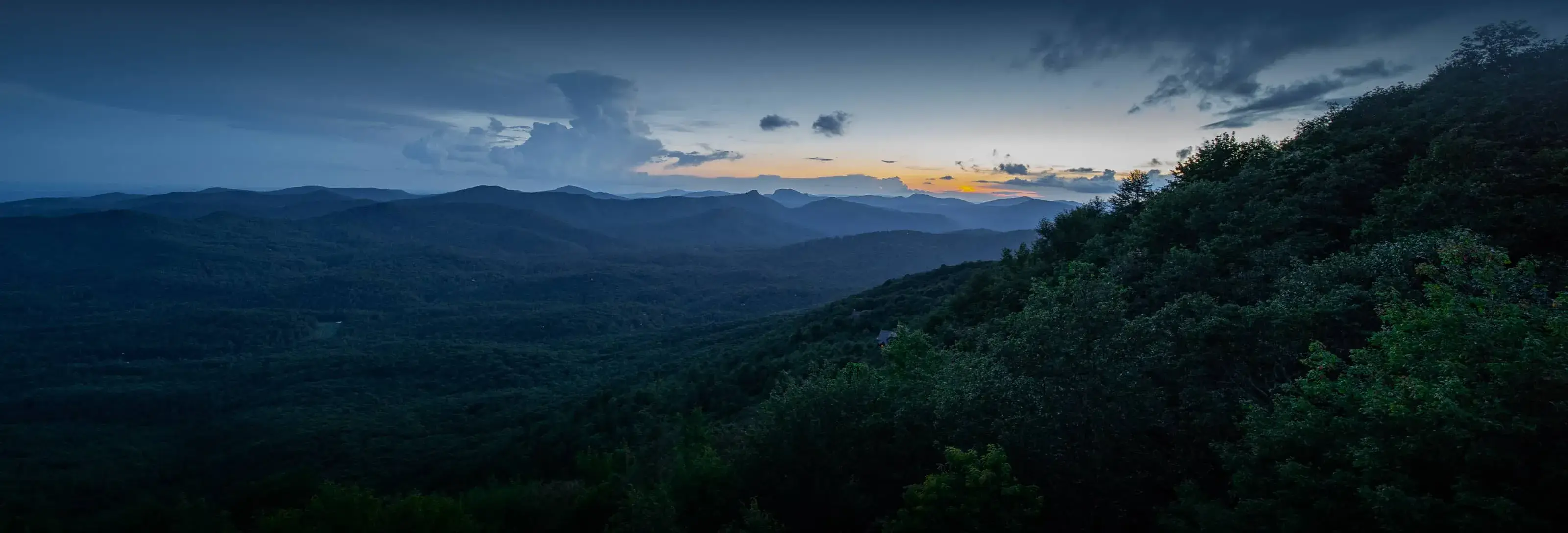
Our high elevation in the Southern Appalachian Mountains provides spectacular scenery and mild summer temperatures, but the extraordinary terrain also serves as an oasis of unique flora and fauna within the region. Along with full-time locals, part-time residents, and weekend vacationers, over 250 geographically unique plant and animal species have made their homes on the Plateau and the surrounding Nantahala Forest. The Highlands-Cashiers Land Trust seeks to conserve and protect that environment for us all while providing valuable benefits to homeowners and landowners who invest in the area.
After 17 years of faithful service, former Executive Director Dr. Gary Wein handed the reins of the organization to Lance Hardin in June of 2023. Here, Lance shares the history of the Highlands-Cashiers Land Trust, his personal experience with the Trust, and an overview of conservation practices, and gives a sneak peek at upcoming activities planned for the new year.
How did the Highlands-Cashiers Land Trust come to be a presence on the Plateau?
“Back in the 1880s, the Highlands Improvement Association launched efforts at attracting more permanent residents to town. Back then, it was simple things like planting flowers in window boxes and installing benches on Main Street, which was still a dirt road. Before long, Captain Prioleau Ravenel, one of the primary landowners at that time, laid a road up Satulah Mountain, and people were building homes up there. By 1909, rumors of a planned hotel venture on top of the mountain swirled around town.
The Highlands Improvement Association objected to the idea of a highly visible hotel on top of Satulah, and apparently, many of the townspeople agreed with them. Within a span of two months, they had raised five hundred dollars, which of course, was a small fortune back then. The organization purchased the top of Satulah Mountain and placed it into a trust to be preserved in its natural state. Even though the name of our organization has now changed to the Highlands-Cashiers Land Trust, that property remains the oldest in our care to this day.
Sunset Rock, donated by the Ravenel family, became the next property added to the group’s protection in 1914. Those were the only two properties preserved by our organization until the 1970s when tax laws began to change. At that point, conservation easements became more impactful tax planning tools and began to grow in popularity. The organization began to grow as more landowners utilized the tax benefits of conservation easements, and in 1987 we formed the Highlands Land Trust. Some years later, we expanded into Cashiers and so became the Highlands-Cashiers Land Trust of today. Despite the name changes throughout the years, we’re actually the oldest land trust in North Carolina.
Today, we conserve over 4,000 acres on 130 separate properties in Macon and southern Jackson counties.”
 photography by Andrew Renfro, courtesy of the Highlands-Cashiers Land Trust
How did you end up as Executive Director of the Highlands-Cashiers Land Trust?
“I spent 25 years as a financial consultant, and for some of that time, I was able to work remotely, before remote work became so common. From about 2006 to 2008, my wife and I lived in Highlands while I worked remotely for a company in Raleigh. So I was familiar with the area and even owned a house here. But after 2008, my company asked me to return to Raleigh. We kept the home as a weekend retreat and moved back to the capital but we were eager to get back here at some point. No question about it, I prefer the pace of life of Highlands and Cashiers to big-city life any day!
I had always been fascinated by the culture and history of western North Carolina, so about eight years ago, I went back to school to seek a master’s degree in Appalachian Studies at Appalachian State University in Boone. At that time, I reached out to Gary Wein and asked if I could help out as an intern. I conducted research on some of our properties and helped with various activities for the Trust.
When Gary announced that he was retiring, there was some healthy competition for the job. But several people suggested I should apply for it too, and luckily the board chose me. I feel blessed to be in this role!”
What exactly is a conservation easement, and what benefits does it provide the landowner?
“Under a conservation easement, a person still owns their land. But they donate the development rights to build on that land, and in exchange, they can earn valuable tax benefits. And once under a conservation easement, no one can ever build on the land.
For example, a landowner might construct a house on 20 acres in Highlands. They enjoy their 20 acres of wooded property and don’t have any desire to see that cleared or to ever experience construction at their doorstep. However, they would have no say in the matter when the property changes hands, either through inheritance or a sale. But when they donate a conservation easement on some of that acreage to us, they know it’s protected forever. And in return, they may earn a tax deduction that helps them.
When considering a conservation easement, the landowner will seek an appraisal of the land, which would consider the value of the acreage if it were developed into a subdivision versus being left in a natural state. After placing their land into the easement, the owner can typically claim a federal tax benefit based on the difference between these two appraised values. Of course, each individual’s tax situation is different, and we always advise landowners to seek their own competent advisors.
The deduction for conservation easements may often provide more value than a standard charitable deduction. That’s because if the value of the donated easement exceeds the usual annual charitable deduction limits, the remaining balance of a conservation easement deduction has a special carryforward period of up to 15 years. Therefore, a one-time donation of land rights to the Trust can potentially reduce the landowner’s taxable income for many years in the future.
But another benefit simply lies in the lifestyle. Many people appreciate living next to a conservation easement. They would rather enjoy the unspoiled forest, along with the privacy and tranquility it provides. They still own the land, and they can continue to hike on it and enjoy it as-is. They’ve just donated the building rights to us, with the knowledge that under North Carolina statute, no one will ever be able to build on land within a conservation easement.
We often joke that easements breed easements because once people learn about the benefits of the arrangement from their neighbor, they often consider placing a conservation easement on their land, too.”
 photography by Andrew Renfro, courtesy of the Highlands-Cashiers Land Trust
What if a landowner doesn’t want to pursue the conservation easement arrangement? Can they simply donate land to you outright?
“Yes, some landowners prefer to simply donate land to us outright, utilizing the standard charitable contribution deduction. If unable to be fully used in the year of the donation, it has a carry-forward period as well, although it’s shorter than that allowed for donations of conservation easements. There are some unbelievably generous people in Cashiers and Highlands and donations of land happen more often than you might think.”
Other than the tax deduction, are there any other benefits to a conservation easement?
“For many landowners, this arrangement comes in handy because, under the easement, we become responsible for stewardship of the land. That means we go out to check on it periodically, make sure no one is dumping trash or cutting trees, and ensure that no one is illegally accessing or using the land, and generally that the land is being maintained in accordance with the terms of the conservation easement. Many landowners feel safer this way, particularly those who don’t live here full-time, knowing that HCLT will help them monitor their property and preserve its natural attributes.”
How do you maintain 4,000 acres of land?
“Stewardship of the land is one of our central purposes and, in fact, is an obligation under our conservation easement agreements. We go out to each property at least once a year, and we accomplish that with both paid staff and some volunteer help. Stephanie Contreras serves as our full-time stewardship associate, and Andrew Renfro works part-time in stewardship and also with me in acquisition.”
 photography by Andrew Renfro, courtesy of the Highlands-Cashiers Land Trust
Aside from conserving land, the Highlands-Cashiers Land Trust is pretty visible in our community. Can you tell us more about your other activities?
Our organization encompasses four main priorities, with conservation and stewardship of land being the first two. As for the third, we conduct a number of environmental education activities, helping everyone from schoolchildren to grandparents learn about the Plateau and the incredible biodiversity of plants and animals that inhabit it. Most people don’t know this, but our area is home to over 250 species that are endemic, meaning they exist here and nowhere else in the world. They’re specially adapted and evolved to survive in this particular environment and nowhere else.
Hope Corbin, our environmental education coordinator, organizes events such as group hikes, trivia nights, and a summer lecture series at the Village Green. Jessica Blackburn, our current Americorps member, conducts our children’s programs with the local schools, after-school programs, and the Boys and Girls Club.
So many people are attracted to this area because it’s beautiful, but we help to explain what’s truly special about the natural resources. Advocacy for our local environment begins with learning about it. Planting those seeds today helps to ensure the success of our organization tomorrow.”
Running an organization like this is clearly a complex job. What are your needs right now and going forward?
“Our fourth priority pertains to the legal and financial obligations that we face. Part of any organization is the governance. There are approximately 1,700 land trusts across the country, but only about 500 are fully accredited. The Highlands-Cashiers Land Trust is one of those that maintains full accreditation. A large part of the accreditation process revolves around ensuring that the organization reserves enough funds for things like legal or environmental challenges to the land. We also have to demonstrate that we have the processes and procedures to provide adequate safeguards for the protection of conserved lands. We are currently in the process of re-accreditation, which occurs every five years.
Julie Schott oversees outreach to our donors and members, from land acquisition to fundraising events. Anyone who wants to help us preserve our local resources and support the efforts of the Land Trust is welcome to reach out to her or to me personally.”
While a number of man-made amenities draw visitors, seasonal residents, and full-time dwellers to the area, it’s the natural resources that provided the original backdrop for our stunning developments here on the Plateau. Vacationers flock here for the mild climate and relaxed pace of life, but they often decide to return frequently or even stay permanently because they find themselves in awe of the beauty of our mountains.
The Highlands-Cashiers Plateau is fortunate to host an organization that seeks to conserve, protect, and educate the public on our abundant natural resources. The Highlands-Cashiers Land Trust fulfills an important role in our community and will continue to provide this invaluable service for generations to come. Lance Hardin and his team express passionate dedication to our land, and they welcome your interaction and support in 2024 and beyond.
Highlands-Cashiers Land Trust is located at 348 S 5th Street, Suite 214, Highlands, NC. For more information, call 828-526-1111 or visit hcltnc.org.